
Beavercreek Neighbors Through Parcel Records
Each Beavercreek record source answers a different question. GIS shows parcel shapes and the identifiers on neighboring parcels. The Auditor anchors the details for one chosen parcel. The Recorder holds the recorded instrument trail. City Planning routes address requests for zoning, permit, and code files, though none of these sources lists everyone living nearby.
| Source | What it shows about a block | Access |
|---|---|---|
| Greene County GIS and tax maps | Parcel geometry, adjacent parcel IDs, road and ZIP context | Public GIMS and tax-map resources |
| Auditor property search | Parcel and owner-oriented property reference | Public address, owner, or parcel route |
| Recorder document index | Recorded transfers, plats, easements, and legal-description clues | Online index from 1984; older books at the county |
| Planning and Development | Zoning, permit, inspection, and code-administration records | Portal for own projects; request existing address records |
| City boards and commissions | Public civic contacts and government bodies | Official city listing, not a membership directory |
Try the Beavercreek street directory for whole-street questions. The block method stays narrow. It covers the target parcel, the parcels touching it or across the right-of-way, and the public records tied to them.
Map a Beavercreek Block in GIMS
The geographic layer for Beavercreek neighbors comes from the Greene County GIMS viewer and its tax-map archive. Search the exact address first. Then select the target parcel. Note the identifiers shown on each adjoining parcel. The county updates parcel data daily from Auditor CAMA. It is a reference map, not a legal survey or any statement of occupancy. The published instructions also describe picking a parcel identifier, choosing Survey Record, and entering a volume and page for an online survey. The tax-map archive adds selected maps plus map and record viewers. The viewer offers no Buffer, Radius, Select Adjacent, or Measure control. Rely on visible parcel lines and plain map browsing.
Ohio's daily voter-registration data page illustrates that a public data system is separate from a parcel map and must be used within its stated limits.
Beavercreek Neighbors and Adjacent Parcels
Identifiers come first, not names. Capture the parcel numbers, then take any owner name back to the proper official record. A name in a deed or property roll describes that record only. It proves no occupancy. It proves no bond between nearby households.
- Enter the exact address in GIMS or the tax-map archive and select the target parcel.
- Visually identify the parcels that touch it or lie across the public right-of-way, then record their parcel identifiers.
- Use the Auditor search for each selected parcel. Its address form can distinguish number, direction, street, suffix, unit, city/state/ZIP, tax year, and property type.
- Use the Recorder index for a relevant deed, plat, easement, or transfer. Compare the legal description rather than relying on a street-text match.
- For an address-specific development question, request the existing city or county record from the office that holds it.
County maps stack several layers. Parcel, building, address, road-centerline, corporation, and ZIP context all appear. The corporation layer splits BEAVERCREEK CITY from BEAVERCREEK TOWNSHIP, which matters because a city mailing label and a governmental jurisdiction can differ.
Beavercreek Neighbors, Plats, and Easements
Some block questions run deeper. Access, lot lines, and subdivisions all qualify. Go to the recorded source. The Recorder supports plat searches by name, plat book and page, or plat cabinet and page. Survey searches run by book and page. GIS survey instructions use the parcel identifier plus a survey volume and page too. A recorded plat explains lots, blocks, streets, and easements far better than any screen outline.
The Greene County Recorder index starts online in 1984. Earlier direct and reverse books come next. The local historic-property guide points to archives, maps, microfilm deed indexes, and the Greene County Room, which helps when a modern Beavercreek parcel reaches into township-era development.
Note: A GIS parcel edge is fine for orientation, but recorded plats and surveys settle any boundary detail that matters.
Civic Contacts Near a Beavercreek Block
Beavercreek publishes no official directory of neighborhood associations. The city does list its boards and commissions. Those are public civic bodies, not private membership rosters. The community layer here is therefore a set of public offices that answer city questions, not an invented roster of neighbors.
Planning Commission
Uses public planning channels for land-use and development matters affecting a Beavercreek area.
Board of Zoning Appeals
Appears in the city's boards and commissions listing for zoning-related civic business.
Parks, Recreation and Culture Board
Provides a public civic contact point for the city's parks and cultural activities.
Environmental Advisory Committee
Is one of the listed municipal advisory bodies, not a block membership organization.
Beavercreek Boards and Commissions is the official listing for these public bodies. It requires applicants to be registered voters living inside city limits. That is an eligibility rule. It is not a route to a neighbor list.
Block issues involving physical change go to the city department matching the record type. Planning and Development handles zoning, permits, and code administration. The city says its online permit center supports applications, payments, status checks, copies, inspections, and results for a user's own project. It offers no open search of every address. That is by design. A narrow request for an existing record at a known parcel is the right alternative.
The official Beavercreek civic-board listing is the verified local public-contact source.
Beavercreek Neighbors and Voter Privacy
Ohio's voter lookup checks one named person. You must enter a first name, last name, and county before narrowing a result by street. The tool is not a street roster or an address-only search. It cannot list a block's voters.
The Data Act channel offers daily county snapshots. It also handles large batch downloads. Registration records remain public, subject to Ohio-law exceptions. Safe at Home participants may use a substitute address, and confidential voter records stay protected. Handle public data lawfully, and remember that an absence from a lookup says nothing about an empty house or a move.
Greene County's inmate search is another public system with a narrow purpose, not a source for identifying Beavercreek neighbors.
Official Sources for Beavercreek Neighbors
A residents directory entry is only as good as its source. Official Beavercreek records show which office keeps a document. They also explain why it exists, who may see it, and how to request a copy. Commercial neighbor-search sites mix data from all over. That blend can look complete. Yet a parcel fact or ownership detail should always be confirmed with the public office that holds the original record before you rely on it.
| Approach | Useful for | Limit to remember |
|---|---|---|
| GIS, Auditor, and Recorder | Parcels, recorded documents, and land context | They do not establish every occupant |
| City Planning request | An existing permit, zoning, or code record for a known address | No public citywide address-result search was verified |
| Commercial neighbor-search category | A lead that still needs checking | Accuracy, source date, and lawful use vary |
Greene County sheriff-sale guidance draws the same lesson for property records. Public listing details belong to the official advertisement, and the Clerk, Auditor, and Recorder can verify anything the listing leaves unclear.
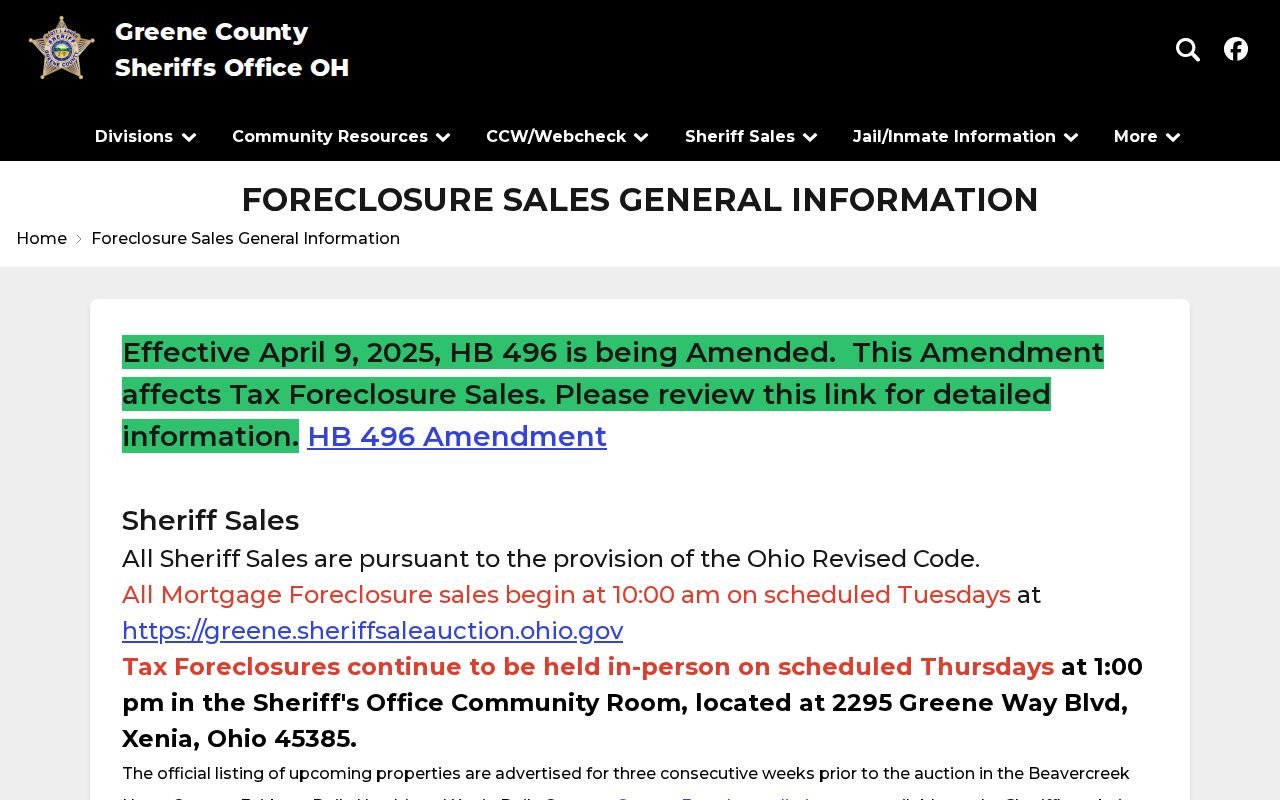
The Sheriff's official foreclosure-sales information shows why a public property notice needs verification at the named custodian.
What Remains Private for Beavercreek Neighbors
A parcel owner and a deed party do not describe a whole Beavercreek household. Nor does a spot on the map. Some things stay private by design. No public residents directory lists renters, household members, utility customers, or delivery recipients. Protected voters and confidential address-program participants are shielded too. Court files, vital records, and recorded documents may also carry redactions or access limits. Ohio Safe at Home, running under R.C. 111.41 through 111.47, gives qualifying survivors a substitute address when they fear for their safety. That rule protects people rather than breaking a search. The Driver's Privacy Protection Act separately guards motor-vehicle personal information. If a record looks wrong or exposes sensitive material, contact the custodian. Ask about its correction or redaction process.
Lawful use. Beavercreek neighbor research can support property curiosity, civic questions, and personal safety awareness. Do not use it to watch, stalk, harass, or harm another person.