
Beavercreek City Directory Collections
Historical directory work for Beavercreek is centered in Xenia and across Greene County collections. The public research confirms that the Greene County Room has historical directory volumes and that the Archives has used a 1915 Xenia City Directory in local research. It does not verify a complete Beavercreek run, publisher list, reverse run, or shelf sequence. Treat the collection as a staff-and-catalog inquiry, not as a promised online list of every Beavercreek household.
| Collection | Verified years | Where held | Access and value |
|---|---|---|---|
| Greene County Room directory volumes | Directory volumes confirmed; 1915 Xenia example verified | Greene County Room, Xenia | Ask staff or use the physical catalog for exact volume, locality, and access details. |
| Greene County Archives directory references | 1915 Xenia directory cited by the Archives | Records Center and Archives | Catalog, repository, Reading Room, and staff assistance support follow-up. |
| Greene County birth registers | 1869–1909 | Greene County Room Digital Collections | Digitized historical probate records with child, parent, and residence fields. |
| Greene County death registers | 1869–1909 | Greene County Room Digital Collections | Digitized records with decedent and last-residence context. |
| Children’s Home records | 1904–1924 | Greene County Room Digital Collections | Historical collection indexed for children, relatives, and caretakers; use with care. |
| Atlases and Beavercreek Township maps | Atlases: 1855, 1874, 1896; maps: ca. 1905 through ca. 1972 | Greene County Room and Archives | Address, road, subdivision, and land context beside a directory lead. |
The missing catalog details matter. No public source inspected gives an exhaustive set of years, publishers, or a verified criss-cross directory for Beavercreek. Request the physical-catalog record or ask Local History staff for the exact Xenia, Greene County, Beavercreek, or reverse-directory volume before relying on a citation.
Beavercreek Historical Room Access
The Greene County Room Local History and Genealogy department is inside Xenia Community Library. It posts Monday through Saturday hours of noon to 5 p.m. Its main genealogy number is (937) 736-7140, and the Local History Manager is reached at (937) 736-7141. The department has a physical catalog, history-librarian-curated digital collections, an inquiry route, and onsite genealogy databases. These channels matter when a web search cannot establish which volume covers a place or year.
The Greene County Room local-history source is shown below. It is the appropriate local first stop for a directory title, shelf detail, microfilm question, or historical address problem.

Ancestry Library Edition is described as available by visiting a Greene County Public Library location. The public page also names newspaper research resources and a training session for NewspaperARCHIVE. Those listings support assisted historical research, but they do not establish that every directory or newspaper volume is remotely available.
Beavercreek City Directory Gaps
The confirmed 1915 Xenia City Directory example is useful but narrow. The Archives cited it in a research trail about residence and occupation when later census access was unavailable. Beavercreek was not incorporated until 1980, so older material can be cataloged under Beavercreek Township, Xenia, or Greene County rather than under the later city name. A zero-result in one catalog term is not enough to say the historical household did not appear in a directory.
Search terms should match the record era. Try Beavercreek Township as well as Beavercreek, then test the road, subdivision, or family spelling against a map or recorded legal description. The local historic-property guide expressly warns that street names and house numbers can change. A city-directory record should retain its observed wording instead of silently converting an old locality or address into a modern one.
Reading Beavercreek City Directory Entries
A Beavercreek city directory entry should be read from the page, not from a generic directory pattern. Local research establishes the occupant-and-address function. The Archives’ 1915 example also supports using a directory for an occupation clue. The inspected public sources did not expose a full scanned entry or an abbreviation key. They do not support claims that every local volume uses spouse notation, ownership symbols, tenancy marks, or a particular abbreviation system.
| Name or householder | Directory function is implied, but the exact layout of a local volume was not inspected. |
|---|---|
| Address | Confirmed by the historic-property guide as part of the directory’s occupant function. |
| Occupant versus owner | Confirmed distinction: directories identify occupants, not property owners. |
| Occupation clue | Supported by the Archives’ use of the 1915 directory in local biography research. |
| Relationship, ownership, tenancy, or abbreviation marks | Not verified for this collection. Inspect the volume’s page and front matter before describing them. |
- Criss-cross directory
- An address-to-occupant directory. Its local availability and year range remain unverified until staff or catalog evidence identifies a volume.
- Householder index
- An index arrangement centered on a household name. Whether a particular local volume uses one must be checked in that volume.
- Abbreviation key
- A publisher’s explanation of abbreviations when a volume includes one. Do not infer a key or its location without viewing the relevant title.
Beavercreek Occupant and Owner Records
A directory occupant and a parcel owner answer different historical questions. The Greene County Auditor’s structured address search begins a modern parcel and tax record. The Recorder’s recorded documents establish a title chain. A historical directory can add the person or household associated with an address at the directory’s date. None of those sources automatically proves every person at the property, present residence, or the relationship among names.
For an older address, establish the parcel or legal description first. Then test whether the historic street name and number align with an atlas, Sanborn material, a plat, or a Beavercreek Township map. This guards against a false match caused by renamed roads, changed numbers, or a later city label. Modern address-keyed records are covered in the Beavercreek street directory research path.
Note: Preserve both the original directory citation and the map or deed reference, because an address can change while the legal land description remains useful.
Tracing Beavercreek Household Directories
Tracing a household across directory volumes is a source-by-source task. The Greene County Room is the place to confirm a volume and ask whether an address or reverse index exists. When a name is found, save the exact title, year, page, spelling, and every visible address or occupation clue. Directory inclusion is evidence of an occupant lead, not proof of ownership or a complete household.
- Begin with the known address or parcel and record the legal description, township or subdivision, and any likely historical street-name variation.
- Ask the Greene County Room for exact directory and reverse-directory holdings for the applicable locality and year. Search the address only when a verified address section exists.
- Record the volume title, publisher if printed, year, page, name spelling, address, and only the entry details visible on the page.
- Pair the entry with the decennial federal census released under the Census Bureau’s 72-year practice, then test the name against historical birth, death, obituary, and newspaper sources.
- Compare a move or number change with an atlas, Sanborn source, Recorder legal description, plat, and the Archives’ Beavercreek Township maps.
A disappearance from a directory may reflect a move, death, altered address, changed name spelling, omission, or a different locality label. It should trigger a targeted follow-up, not a conclusion. The best evidence is the original directory page paired with the library or archive catalog citation.
Beavercreek Vital Record Sources
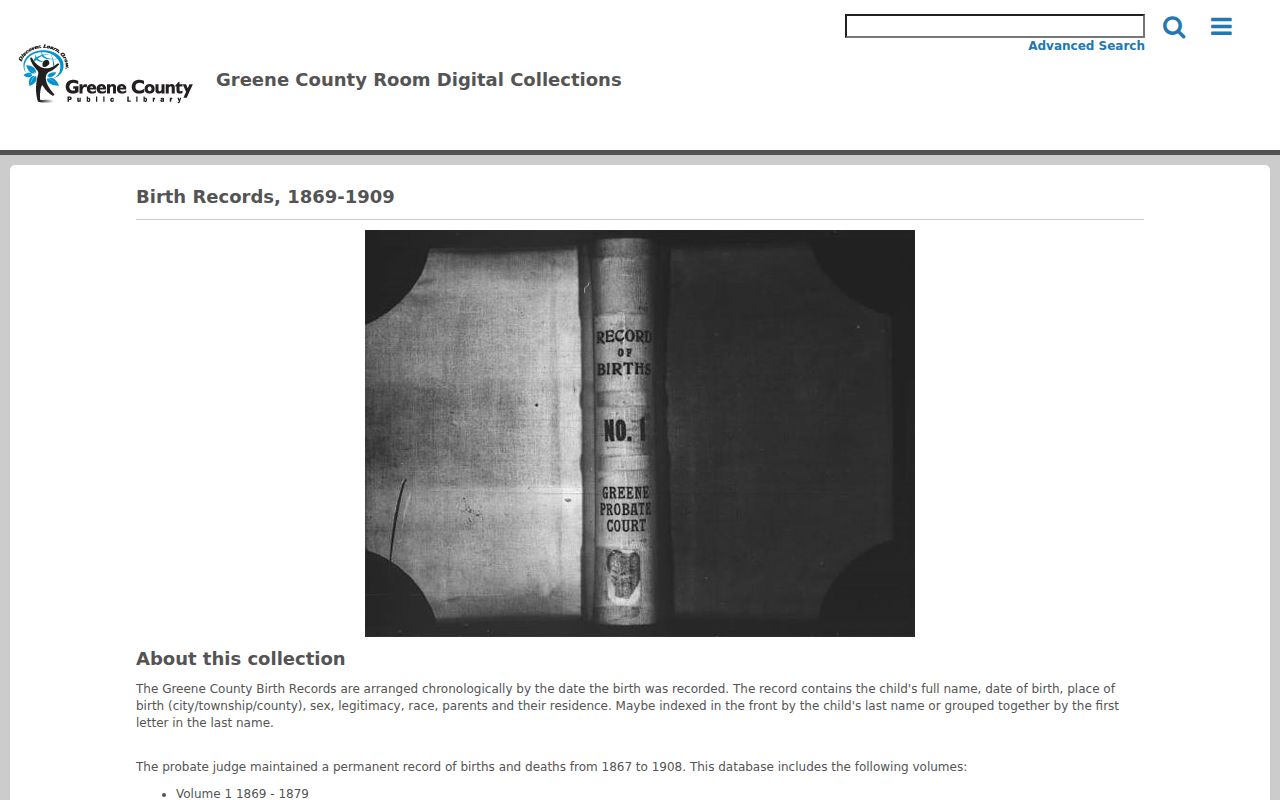
The Greene County birth-record collection adds dated historical evidence beside a city-directory lead. The digitized probate birth volumes cover 1869–1879, 1880–1892, 1893–1903, and 1904–1909. Their description identifies the child’s full name, date and place of birth, sex, legitimacy, race, parents, and parent residence. The parallel death collection covers 1869–1880, 1881–1893, and 1893–1909 and includes decedent, death date and place, marital status, age, last residence, birthplace, occupation, parents, and cause of death.
The official Greene County historical birth-record collection is pictured below. Use the digital record as historical research and follow the collection’s instruction to contact the contributor for an official copy.
These registers can anchor a surname, family, or residence at a date. They should be handled thoughtfully, especially when the surrounding circumstances are sensitive. They do not fill the unverified city-directory shelf or turn a historical name into a current address.
Beavercreek Directories and Maps
Maps are the bridge when an old directory address does not match a modern one. The historic-property guide names Greene County atlases from 1855, 1874, and 1896, Sanborn insurance maps, directories, deed-index material, obituaries, census resources, and newspapers. The Archives map inventory has Beavercreek Township entries from about 1905 through about 1972. It includes examples such as Knollwood Estates maps from 1939, 1946, and 1947, and an Eastern Hills/Coy plat from 1952.
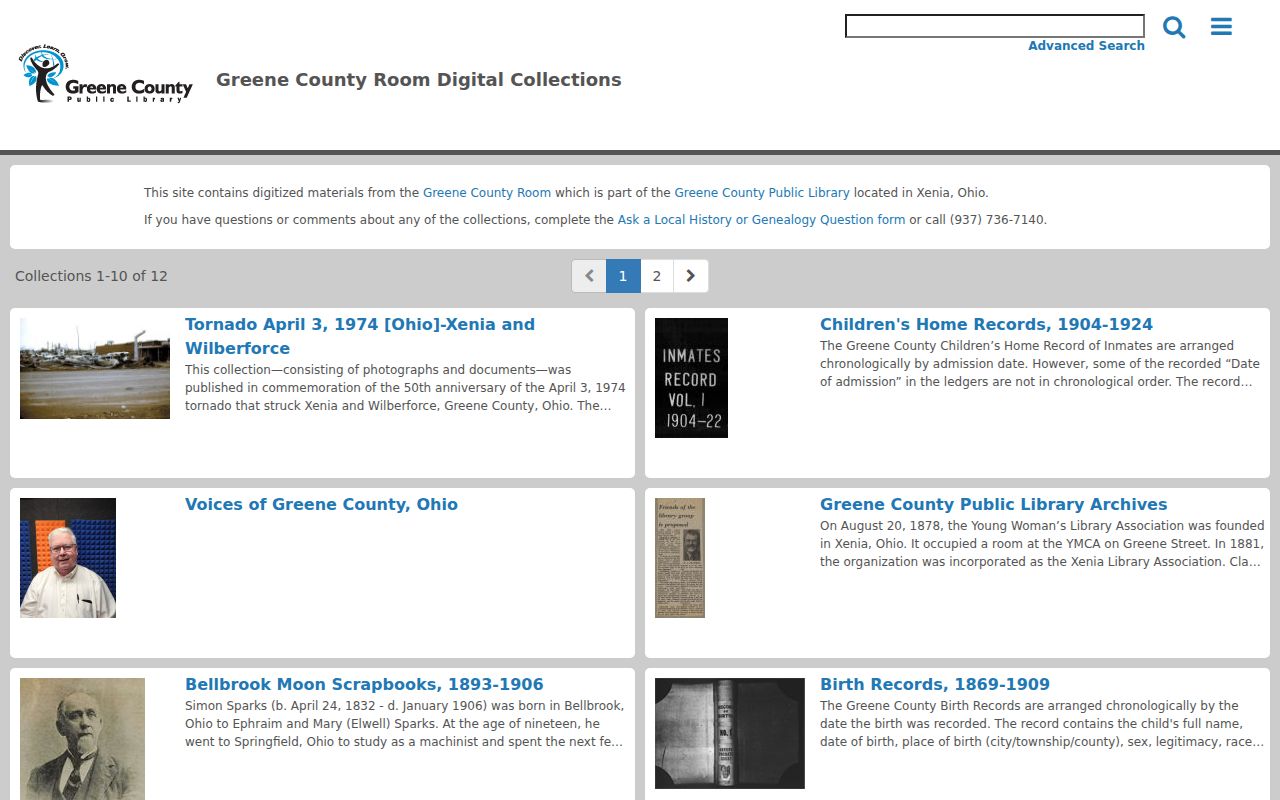
The Greene County Room Digital Collections landing page is shown below. It is a starting point for digitized county history, while the physical catalog and staff remain necessary for material not exposed online.
For newspaper context, the Greene County Room lists the Cincinnati Enquirer for 1841–2009 and the Dayton Daily News for 1898–1922 in its research databases. Its obituary collection is also confirmed, though the year run is not published. Read a map as geographic context, not title proof. The recorded plat, survey, or deed is the legal source when ownership or boundaries matter.
Beavercreek Archive Records Timeline
The history behind the local shelf explains why a city-directory search needs both digital and in-person channels. Greene County was created in 1803, and its first Common Pleas organization meeting was held in Beavercreek Township. The county seat was later placed at Xenia, which helps explain the current custodian geography. The courthouse fire in 1900 and later preservation work also mean that an online gap does not identify the whole historical record.
| 1803 | Greene County was created; the first Common Pleas organization meeting occurred in Beavercreek Township. |
|---|---|
| 1900 | The Greene County Courthouse was destroyed by fire. |
| 1950 | Photostat copies of John Paul’s 1803–1807 minutes were made and presented to the Greene County Library. |
| 1971 | The Greene County Room was founded, according to the library’s digital-collections history. |
| 1980 | The City of Beavercreek incorporated, so earlier local material can use township or county terms. |
| 1996 | The county archives program began after permanent records had been stored in scattered locations. |
| 2025–26 | The Archives reports an ongoing migration of elected-official search material and Engineer Map Search content into catalog and repository systems. |
The timeline does not establish a directory publication sequence. It explains why a directory lead may require a catalog search, reading-room visit, or staff request before its surrounding records can be located.
Checking Beavercreek Directory Evidence
Use the Greene County Room and the Greene County Records Center and Archives together. The Archives has an online catalog and digital repository, but says not all holdings are digitized. Its Reading Room is non-circulating; visitors are welcome during normal hours, appointments are recommended, and fragile material may not be copied. Those are meaningful access channels for a directory citation, map, newspaper clip, or house-history trail that does not appear on a public web page.
Family-history follow-up can also use Beavercreek’s Grave Discover search for city-managed cemetery research. The City links its search and map route for Mount Zion Park, Aley, and Hawker. Cemetery evidence, an obituary, a directory page, and a birth or death register may each add a different historical fact. Keep the source boundaries clear and verify a conflict with the office or repository that holds the original record.
Note: A historical city-directory match is most reliable when its exact citation, date, and address agree with at least one independent local source.